
The Model of Change

Dr Joanne Ladds, Noble + Eaton
“Your environment is your curriculum.” This was a comment I made at Reputational Management, the Noble + Eaton workshop at Tormead School on 21 June 2024, when Peter Forrest-Briggs, then Assistant Head at Farnborough Hill School and now Deputy Head at Sir William Perkin’s School, asked about the importance of our work and its impact in schools.
That workshop was the first of many workshops and conferences from Noble + Eaton and Envoplan. It was unusual: we shared the detail of the design work in the space itself, to train others. It set a new precedent for collaboration and partnership, and a new baseline for design.
The event was run with Dr Stephen Holmes, Founder and Principal of the 5Rs Partnership, and drew on his work on what he calls “the physical habitat”. Together we linked the vision, mission and values of a school to specific features in the design of a Sixth Form completed by Envoplan. The presentations covered our model of change and future developments in technology, which are now being realised in designs worldwide.
Our Model of Change
Our Model of Change: nine linked stages, from environment to genetic expression. Light green stages are linked through Bloom’s taxonomy, dark green through Maslow’s hierarchy of needs.
The environment is a driver for change. Our model of change describes the relationship between the environment and behaviour. It shows how changing the environment can bring about a change in behaviour, and what to consider when you start designing. Through it, we can identify a school’s cultural models and design, or redesign, an effective architecture that improves reputation through enhanced cognition and wellbeing.
The model is a cycle of nine linked stages: environment, language, perception, personality, attitudes, behaviour, habits, neuroplasticity and genetic expression. Each shapes the next, and the last brings us back to how we respond to the environment.
It starts with the link between the environment (place) and language, through the Sapir-Whorf hypothesis: the idea that the language we use shapes how we perceive the world around us. Our perceptions of the environment are understood through this theory, and developed further through the relative nature of language in context, through cultural perspective and through social hierarchy (people).
From there, the model links to attitudes and behaviours, which develop into habits, and ultimately to reframing thinking through what we understand from neuroplasticity and epigenetics. All of this requires a clear baseline: each learner’s predispositions have to be fully characterised first.
Let’s use terms that aren’t all about the science but apply to any setting. We are all learners, after all, and we all want to be the very best versions of ourselves. For a school, this is about positioning: capturing its brand from the inside and aligning it with an understanding of its external relationships. The science, again, is being able to link thinking to embodied cognition in real time.
This has meant returning to school purpose, and not relying only on IQ, or even on cognitive data as it stands. People don’t, or can’t, say what they think.
Why now?
Why does this matter more now than ever before? A personalised model for learning is now realistic. It is no longer possible for the few and impossible for the many.
More than this, it is no longer a local question of “what does a good one look like?” but a global question about the purpose of education. The proposition becomes less about what we are doing and more about what we are holding back from what could be possible.
We now have a tool that removes frameworks we once reserved for a particular region, country or community. We have a lens through which we can create learning pathways based on frameworks of thinking. Designing for this is fundamentally different, and while we consider it from a school perspective, the world is already using digital tools to reshape the landscape.
Early adopters are learning from their mistakes. Those grasping the opportunity now have a starting point, but are they eager to learn about the next wave? That is the next iteration, and it will include late adopters who could be positioned to move quickly. Where are you?
It is no longer a question of mobile phones in schools, or even whether AI can be excluded. Which activity, which resource, and why? What is non-negotiable because we know the learner makes progress through that type of activity? That is what is possible.
How we position digital literacy to resource learning potential is no longer a question for schooling alone. It is a question for every phase of education, and for developing human capital to improve lives.
A global question
Looking at this only from a UK perspective means using SEND as a category, and that category isn’t used in the same way across the world. The UK’s method of categorisation is underpinned by policy that treats learning through a “can’t do yet” lens, based on data from standardised, age-related IQ assessments. That model can’t be sustained in its current form, because we have found that it applies to so many more learners, and so many more environments.
With that potential comes greater responsibility. We can keep saying we are doing what we can, or we can say we now know what is possible, so why are we not taking the opportunity to change the landscape? I know where I sit.
This new information brings an immense amount of learning about how learning happens. The shift we need is to use this data to design for what learners can do, and to use data collection to connect and guide.
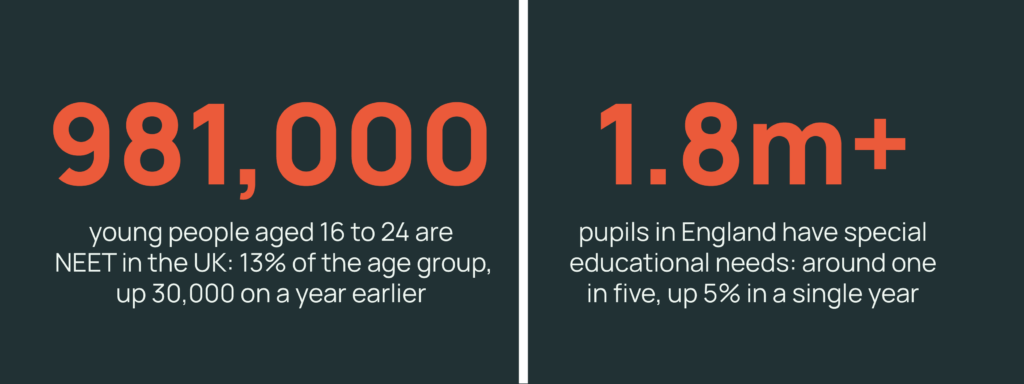
The stakes are high. Nearly one million young people in the UK are not in education, employment or training (NEET), and the number of pupils with special educational needs keeps rising. Behind every one of those figures is a learner whose potential we have the data to design for.
We have more technology than ever before to support learning, and we are passionate about making this work. We need clarity on what works, so that we are not guessing. We don’t want guesswork.
We do want people to trust their instincts and to support those they work with. That takes confidence in what is possible. It asks you to trust our data, and to trust that you can have an impact on a learner in your school that will make a difference to their life for good.
Looking back to look forward is something I have written about before. The context through which we do it is what matters.
Rethinking assessment
We need to step back and realign some assessment designs with this new lens on education. We have had a full curriculum review: did it consider intent, but also implementation and impact? If so, what were the assessments? IQ assessments were designed for a particular purpose that no longer matches what technology now makes possible. Assessments for learning interventions, too, have been built around gaps in learning seen through that lens. They have helped us understand learning biases, the potential for adding value and how to reduce those gaps.
We have taken a huge step forward by rethinking what this data could be telling us. It started with a conversation between Dr Adam England, Director at Noble + Eaton and Executive Headteacher, currently Principal of Rugby School Nigeria, and GL Assessment: a dataset, a frame and a set of designed assessments to understand the profile, in CAT4 and the suite of assessments linked to it. The profile was the solution, and it also showed us the next problem.
Having used these assessments myself, I understood their value for teachers and for learners. But how can we show learners what metacognition really is? How can we show them what it is to think, and to thrive in their thinking? To love learning?
From profile to practice
How can we design schools for engagement in learning? That meant aligning activities with what the data was telling us. The challenge was how to make best use of the profile data: what was working, what wasn’t, and how did we know?
Our question was no longer about the model of change; the research was clear. It moved to the activities, and to collecting data on their impact. As Dr Adam England reminded us, “if you do what you have always done, you will get what you have always got.”
It meant creating learning pathways for a learner profile based on the way that learner acquires language, rather than trying to “fix” or close gaps where a particular type of language has not yet been acquired, whether spoken, written, numbers or words.
Designing for potential
This took a further leap into the unknown when we began looking at the data at a micro level rather than a macro level, and mapping learners as assets rather than through a deficit model. Instead of learning gaps, we are looking at what it means to design for potential: wellbeing (Maslow), cognition (Bloom) and performance (impact).
What if we focus on strengths and push those, while continuing to develop the areas where learning is still developing? Doing this continually needs new types of dialogue, new experiences and new methods of data collection for precise, accurate mapping.
We needed to develop the technology to capture the nuances of learning, and to frame how self-identity can be developed through place identity. From there, to which activities work for different learners, and why. Is there a pattern or trend to work from? Can it be sustained? Once the micro level is understood, can it be pulled back to the macro level?
What we came to understand is that much of this comes down to the speed at which information is processed. The way information is presented can be designed to support each learner.
That is different for every learner, whether they learn by observing others, by listening to others or by having a go themselves. Some activities can mask the impact of any one of these interventions. How do we unpick this to know what works?
How do we move beyond memory acquisition and retrieval to applying learning in context? How do we stack, scaffold, interleave and block learning, whether subject-specific or project-based? How do we capture skills acquisition?
We needed to understand thinking through our studies in neuroscience, and its application through studies in psychology, with the environment as the driver for change. That was, and still is, the model.
The unexpected result
The impact has raised the profile of all learners. We did not expect that.
Seen through the lens we have always used, it could even be classed as a failure: if every learner moves forward, the gap does not close. That has been the second challenge. Understanding profiles is one thing. Designing activities that add value based on values, and showing the impact, is a whole new world.
Why bother?
It came back to the question: why change, if what we do is working well enough?
From a purely financial perspective, if we can’t design something repeatable, reproducible and deliverable efficiently, with no more resources than we have, how do we get buy-in? Better quality learning, better experiences and added value for all. Why wouldn’t we?
My problem? I never do what is easy. I add too much detail, overthink the method and don’t always realise what we already have. When you know something works, you just know. How do we show it? That one question captures it all, and I hadn’t even realised it.
Resilience is one of the factors we needed to build into the design. Again, resilience in context: what does it look like, and how can it help a school’s brand continue to grow and develop?
There is no gap
So what do we do now? Change to try to close the gap? No. My point has always been that there is no gap. There is a vision for learning through the lens of who a learner is, what they would like to achieve and how we help them get there: by creating opportunities, making connections and making dreams come true. So nothing has changed. We are just better at doing what we have always done.
Can we keep doing the research? Of course. There will always be changes in society to navigate, new resources to consider and new ideas to investigate. This work will never be finished; there will only be new iterations, and new people to drive the passion and determination.
We need to apply what we know now, never forget what we have achieved, and remember that we are all just trying to find our place in the world.
© 2026 Dr Joanne Ladds. All rights reserved.
SOURCES
Department for Education, Special educational needs in England, academic year 2025/26 (published June 2026).
Office for National Statistics, Young people not in education, employment or training (NEET), UK: August 2026 (April to June 2026 data).

Leave a Reply