
What Measuring Actually Looks Like

September is when it starts. The governor meetings that will decide next summer’s projects are already in diaries, the budget conversations that will fund or defer them begin this term, and any school hoping to deliver work in the next holiday windows is now on the clock.
This series has made one argument in three parts. Good estate projects fail for reasons that have nothing to do with design. The missing ingredient is almost always evidence, a baseline the sceptical governor in the final room can test. And when schools do measure, the case that emerges is stronger and more affordable than the one instinct would have written. Each article ended on the same question: what is your current proposal assuming that nobody has actually measured? So the last piece belongs to the obvious follow-on. What does measuring an estate properly involve? It has three parts, and the first things to say are what it isn’t.
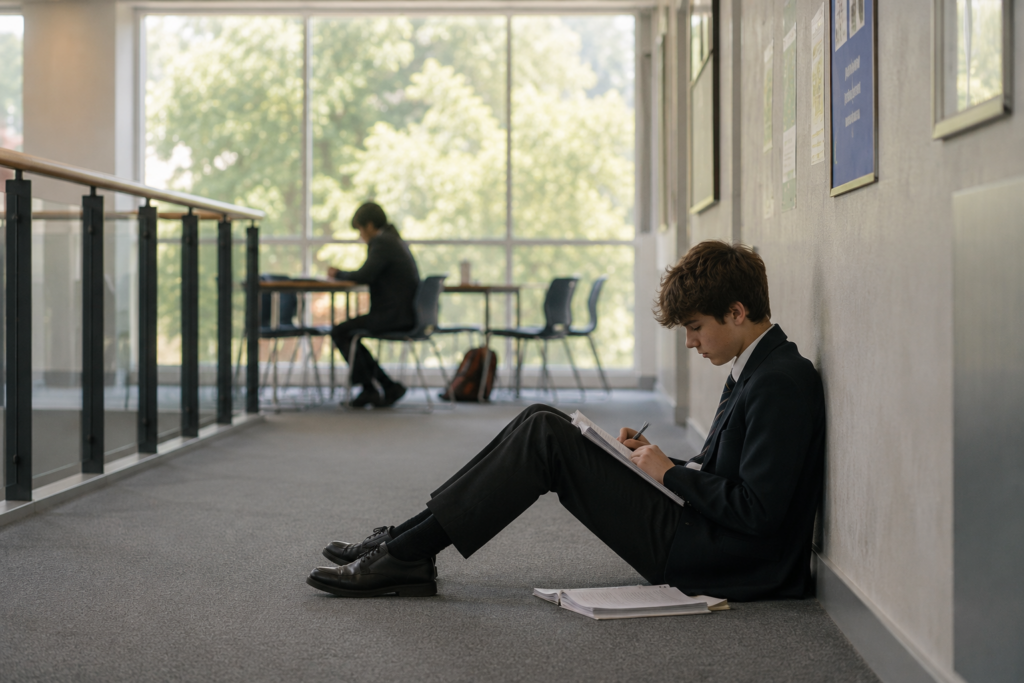
It isn’t watching what pupils currently do. That’s the instinctive place to start and it’s a trap. How pupils use a school today tells you very little, because behaviour bends to constraint. Pupils revising in a corridor aren’t telling you the corridor works, they’re telling you there’s nowhere better. Observed behaviour is the estate’s output, not its measure, and reading it as preference is how schools end up reinforcing the very compromises they should be designing out.
And it isn’t the surveys most schools already hold. A condition survey measures fabric. A utilisation survey measures occupancy. Both are worth having and neither measures function, whether a space can actually support the kind of learning that needs to happen in it. A school can hold a clean condition report, respectable utilisation figures and a masterplan, and still have no answer to the question a board will ask: what is this estate doing for our pupils? That’s the measurement most schools have never taken.
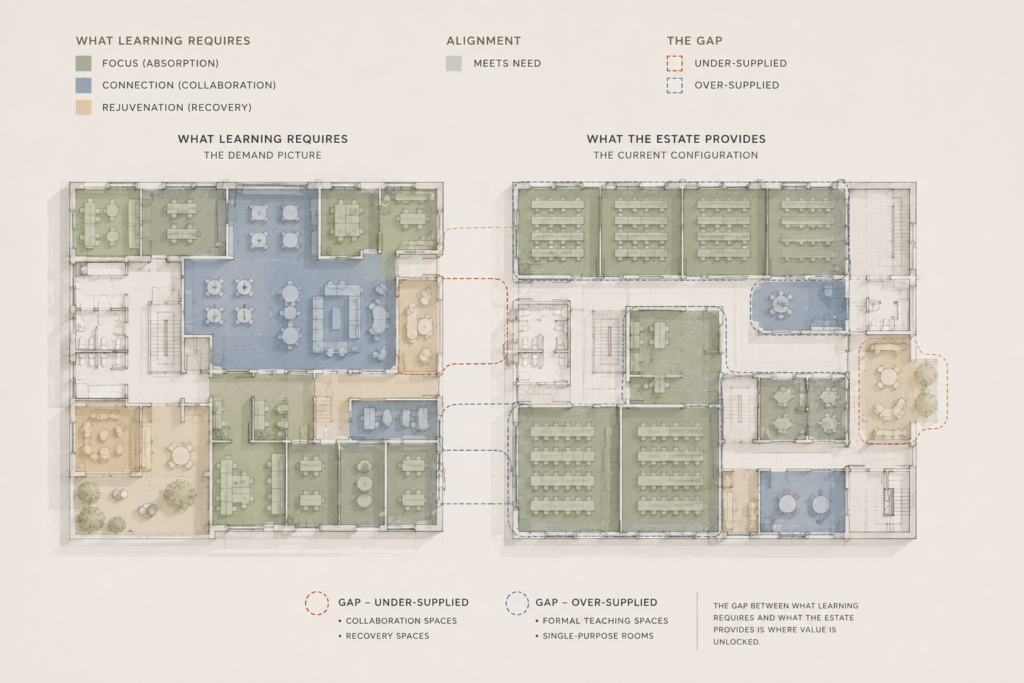
Start from the science of how learning happens. The demand side of the measurement doesn’t come from the building, and it doesn’t come from the curriculum alone. It comes from the research on embodied cognition and information retention, the growing body of evidence, explored in the second article of this series, showing that learning is shaped by the interaction of mind, body and environment. Learning requires an alternation of conditions: periods of deep, sustained focus in which information is absorbed; social connection through which understanding is tested and embedded; and genuine recovery, because attention and retention degrade without it. The science gives the demand picture its shape. It tells you effective learning needs all three conditions in deliberate alternation, and it tells you when an estate has starved one of them. That benchmark exists independently of any school’s timetable or any architect’s drawings.
Overlay the curriculum, then measure the gap. The curriculum then makes the benchmark specific to the school: what is taught, to whom, in what volumes, with what patterns of practical, collaborative and independent work. Science overlaid with curriculum produces a demand picture, the mix of absorption, connection and rejuvenation environments this school’s pupils need to learn what this school teaches. Against that sits the estate as it’s actually configured today, coded by function rather than the name on the door. The gap between the two is the measurement. It’s what produced the findings in the third article: formal teaching space carried beyond what the demand picture justifies, connection and recovery space starved below it, whole tranches of capacity sitting unquantified inside estates a school already owns. None of it is visible from walking the corridors, because the corridors only ever show the symptoms.
Understand the learners the estate has to serve. No demand picture is experienced identically by every pupil. The science and the psychology are clear that different learners need different conditions to do the same work, and an estate configured for an imagined average pupil quietly fails the pupils at either side of it. This is also where staff and pupil experience earns its place in the evidence, not as a record of preference, but as a way of understanding where the current configuration is forcing workarounds. It’s the strand that lands hardest with governors, because it connects the analysis to the pupils they’re responsible for.
Why this order matters. Get the estate to match what the science and the curriculum together demand, informed by the range of learners in the school, and behaviour turns out to be the easiest thing to change. Pupils and staff move towards spaces that work, with remarkably little persuasion required. Schools that start from behaviour try to change the hardest variable first with the least information. Schools that start from the science change the environment once, and let behaviour follow.
What it produces. A baseline of how the estate is configured today against what learning actually requires of it. A specific statement of where the gaps are and what they’re costing, in retention, in unusable capacity, in pupils working around their environment instead of in it. And a set of options that can be phased against the school’s own calendar and budget, because measured problems come with their scale attached. This is the evidence pack the whole series has been describing: the thing that answers the sceptic, moves the estate from the cost line to the revenue line, and turns a conviction into a case. Every example these articles have drawn on, the 25 percentage point retention gain, the 352 places found inside an existing portfolio, the scheme that went from unaffordable to approved, started this way.
Facts first, business case second, boardroom last.
The sequence is the whole discipline, and it’s worth being clear about the scale of its first step. Establishing this baseline is weeks of work, not a capital project, small against the size of the decisions it informs. Most schools nevertheless run the sequence in reverse: the proposal is written from conviction, the board asks the evidence questions, and the project stalls in the gap. Run forwards, the same questions get answered before they’re asked, and the case that reaches the final room is one the facts wrote.
The projects that get funded this year won’t be the best designs. They’ll be the best-argued cases, and those will belong to the schools that established the facts before they asked for the money. So, closing where the series began, with the sceptic in the final room. Could you show them, today, the gap between what your pupils need and what your estate provides?
Fourth in a four-part series on estate investment in independent schools, drawn from the framework Noble + Eaton has developed and applied over six years of research and delivery. Previously: “Why good projects don’t get funded”, “The evidence your board is waiting for” and “The case they didn’t know they had”, all available on our website.

Leave a Reply