
Space and time: The overlooked ingredients in successful school design
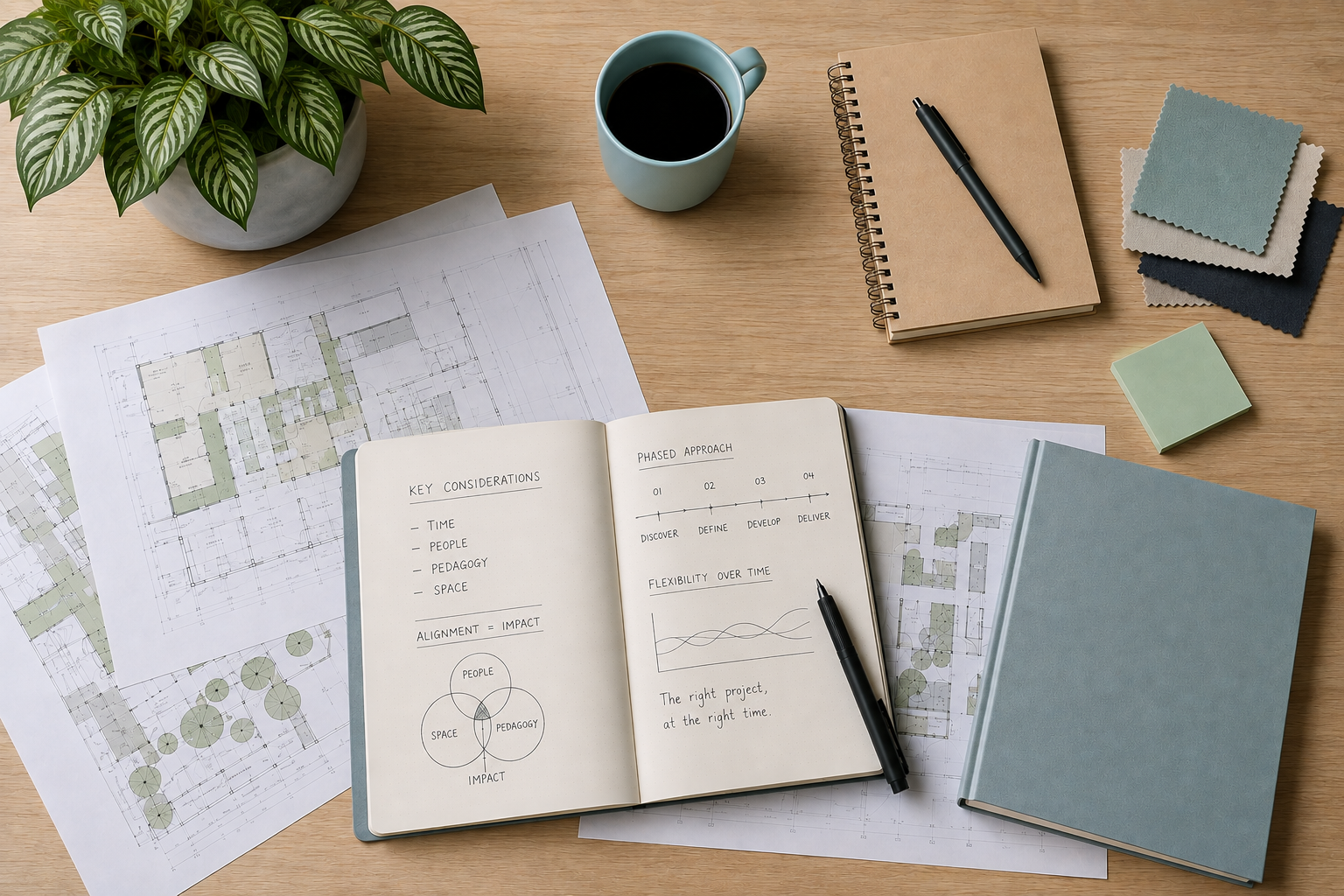
This week has been another rollercoaster of events to weave together for you in a story of determination. A line from one of my favourite songs “burning with determination to even up the score’ captures it well.
This time of year is when the holiday season starts at the same time as strategic planning. It feels like a strange mix of the perfect opportunity for reflection and new ideas, whilst not having your whole team with you, and the budgets have already been set! With some people changing roles, with some people moving schools, others getting to grips with the ‘to do list’ that didn’t get completed in term time, and a blend of travelling and seeing friends. This time of year, is just fundamentally different.
New teams and fresh ideas based on previous audits and forecasting; is there any other business model that works in such a staggered, stop, start mechanism? Blocks of time allocated around, well, there is the question to get us started; what are your blocks of time in school allocated around? Are they adaptable, flexible when they need to be? Are they efficient in terms of their effectiveness and impact, not just efficient in terms of speed?
Have you considered how your time could or should be allocated through this lens?
The accelerator and brake mode was my only mode; acceleration in school during term time with the brake on family activities, applying the reverse during the holiday time.
Our work at Noble + Eaton with the Envoplan Group is different; the accelerator and brake work together seamlessly going up and down the gears at the right pace for a school. When you learn to drive with the gears it becomes automatic, the engine drives itself, and in any conditions.
Can you say the same about your school?
With our methodology secure, efficient, impactful and underpinned by research we are moving into our next phase. At our Sixth Form conference we mentioned Thriving SpacesTM #3 and Thriving SpacesTM #4, we are blurring those lines by reducing the time spent to reach a bifurcation point so we can move quickly and confidently into a new growth phase.
How? We use our methodology with our teams and the schools we work with.
We are confident with our data collection and the data we collect. Whilst we will always look for the very best research to ensure that our designs are the very best they can be, we are secure with our process, with the confidence to continue to grow.
If we know what works, why it works, and we know where it works; how do we grow?
We are changing our focus from the process to focus on timing.
An engine, just like a school, has many factors that affect its drivability. Some of the factors that change how it feels to drive are its relative size, energy input and the spacing of the gears. For school designs to be timeless, for them to be ‘Thriving SpacesTM’, once the size and input are understood, when the gears have been sized and orientated, they need to be spaced and timed so they can connect and work together.
My point?
We have always encouraged anyone we work with to consider a different planning and delivery schedule and not to rely on the summer holiday period; this is going to be a real focus for us moving forward.
We know our process works, now trust us to guide you on your project delivery timing for maximum impact.
You can have confidence that our preparation delivers results for you 365 days of the year. We want to encourage you to consider the spacing and timing of your projects in the same way. Starting your project at the right time is just as important as the project itself. This is essential for all schools whether they are local, national, international or global.
If you want the very best schools, the very best teams within your schools and the very best designs for the most impactful spaces, you now need to use space and time as your unique identifier. What you do AND when you do it matters more now than ever before. This doesn’t always mean faster; it means strategically phased planning for every space in your campus.
Our work this week reflects this focus for 2026/2027. Catching up with the team, thinking about who and how we can connect with schools, online meetings, emails, writing a report for a research grant, and diving deeper into the ‘so what next’. Oh, and it has been my birthday! I have felt very special; great company and great conversations. How do I sum all of this up?
Looking at the design of schools through a commercial lens is something that requires a shift in not only the data collection but also the systems we use to collect, connect and consider the opportunities that we have. If we do what we have always done, we will get what we have always got.
To be able to design schools for personalised learning we need to connect what we have in new ways. We need to use space and time differently.
- It is not a shift to ask people to do more work or to just reduce contact ratios by having more people. It is about the right people working together, in the right place at the right time
- It is not a new curriculum, or more assessments. It is about connecting the curricula and the assessments in new ways to showcase learners as assets to society
- It is not about one space or even one place for learning. It is about the right the right people, with the right activities, in the right places, at the right time
What was once fixed needs to become continuous; what was once flexible needs to be fixed around the new strategies that we can design. Whilst resources in terms of people and pedagogy offer potential, we must connect them to the right places for their potential to be realised.
We are seeing huge changes in the market. This apparent nervousness is delaying decisions and schools are even putting projects on hold. We know that projects should not be put on hold because of the impact of not doing something can be worse.
Remember that uncertainty is not always financial, the barriers we deal with are interconnected, systems related, and unique to each school. Find them, to remove them, design with them in mind.
Quality remains the non-negotiable.
To be able to achieve quality at scale requires front loading, phasing, staggering and stacking through the right positioning. This is understanding attention economy through context transferability. This is what we do.
Quality requires honest conversations with schools.
When we connect the values of a school with the problem they are trying to solve, you can design for their purpose. A knowledge of the building is fundamental, but this knowledge does not get the result or the impact a school is looking for on its own. Instead, we:
- Design for potential capacity rather than current capacity
- Design for potential positioning not the current positioning
- Design through purpose and the contribution a school will be able to make to society
- Design for impact
- Design for Thriving SpacesTM
These designs build confidence.
We design with our head and our heart.
Dr Joanne Ladds – Associate Education Consultant

Leave a Reply